


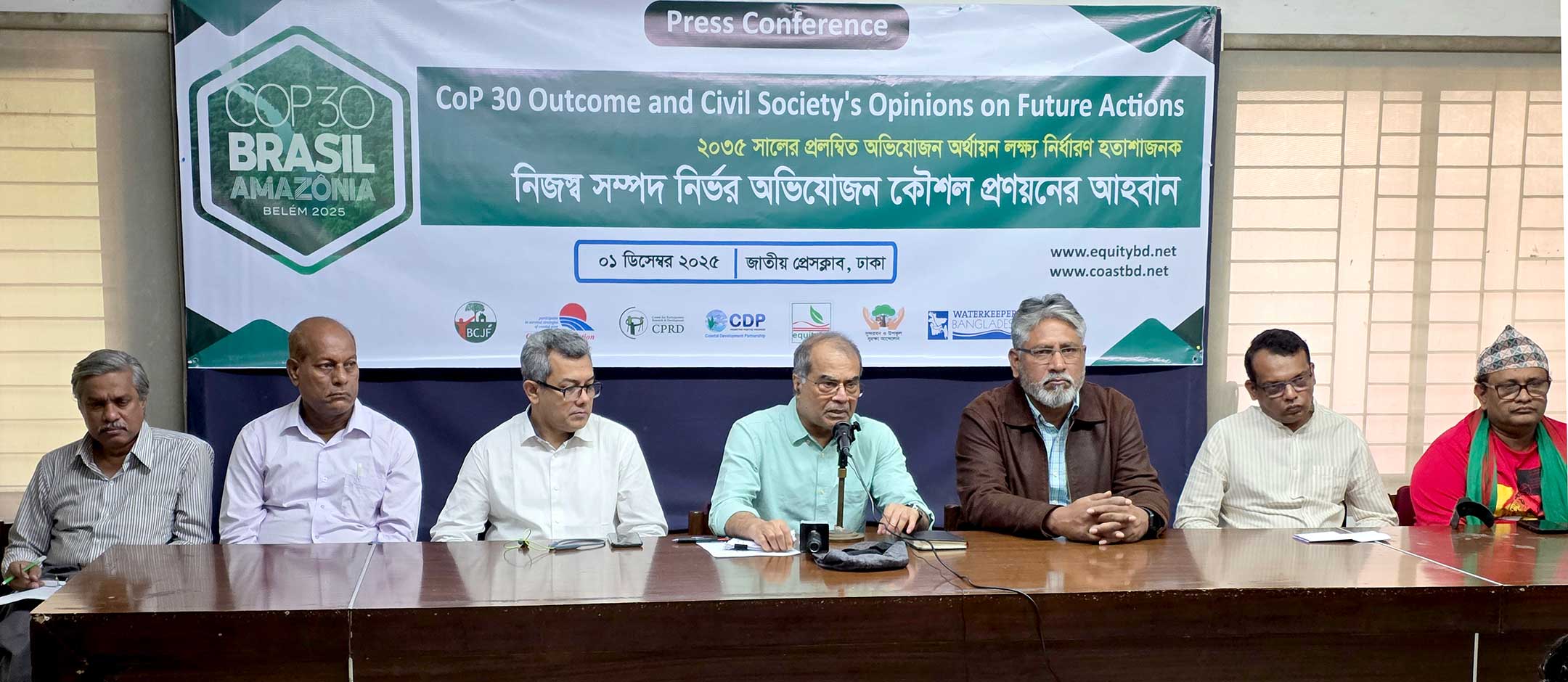
CoP-30 Outcome and Experts’ Opinions; Deferred adaptation finance threatening for LDCs
Need Own Resource-Based Robust Local Adaptation Initiatives
Dhaka, 01 December 2025: Without clear commitment of climate finance and roadmap for phaseout of fossil fuels, the Belém Agreement (COP-30) completely failed. The call for voluntary rather than obligatory reductions in fossil fuel use essentially ignores the root cause of the global climate crisis, the world is now heading towards 3 degrees of warming in the absence of a realistic way to keep global warming to 1.5 degrees Celsius. They also said, proposed triple adaptation financing goal has been pushed back from 2030 to 2035, and without a baseline. This deferred financing target is just a strategy to avoid responsibility of the developed world, and the survival crisis of LDCs & MVCs like Bangladesh has become more acute. Therefore, Bangladesh should build strong local adaptation measures based on its own resources to protect millions of climate-vulnerable people.
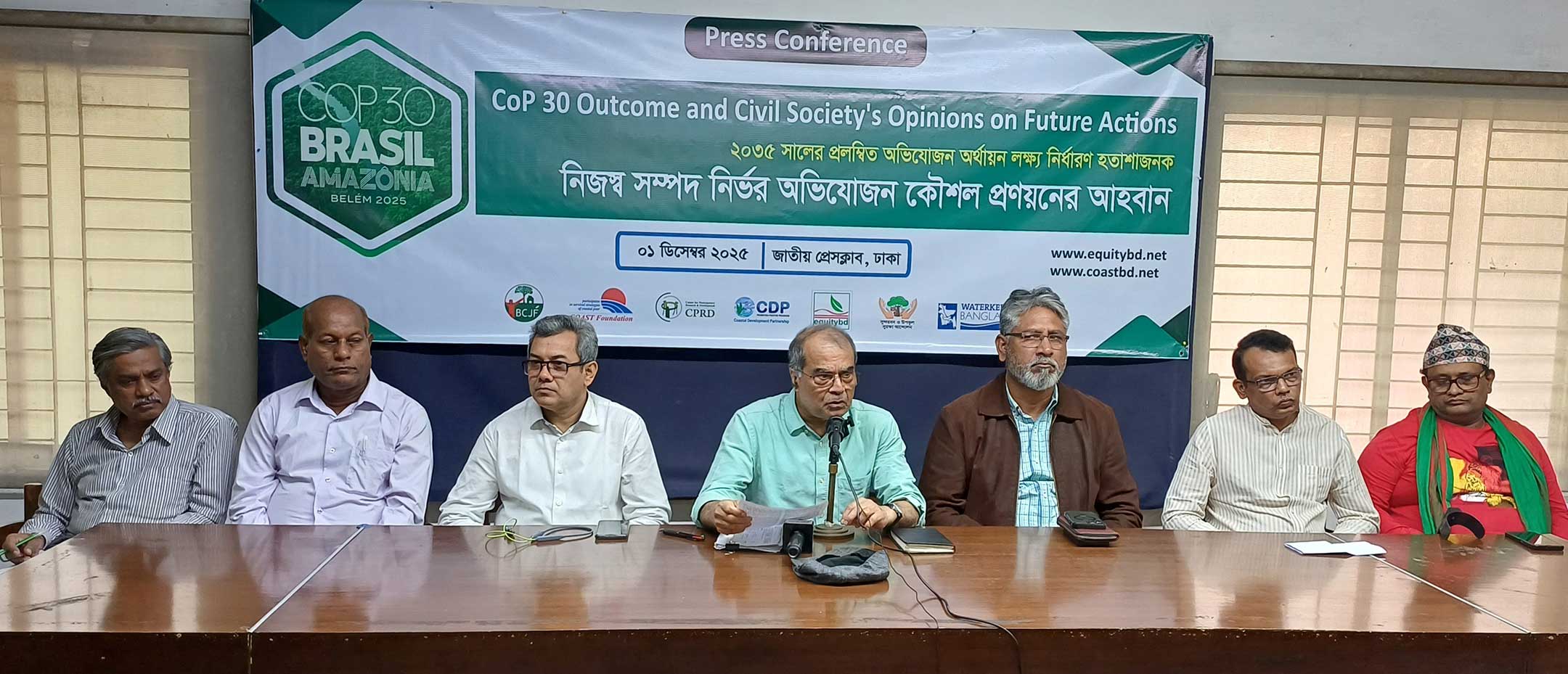
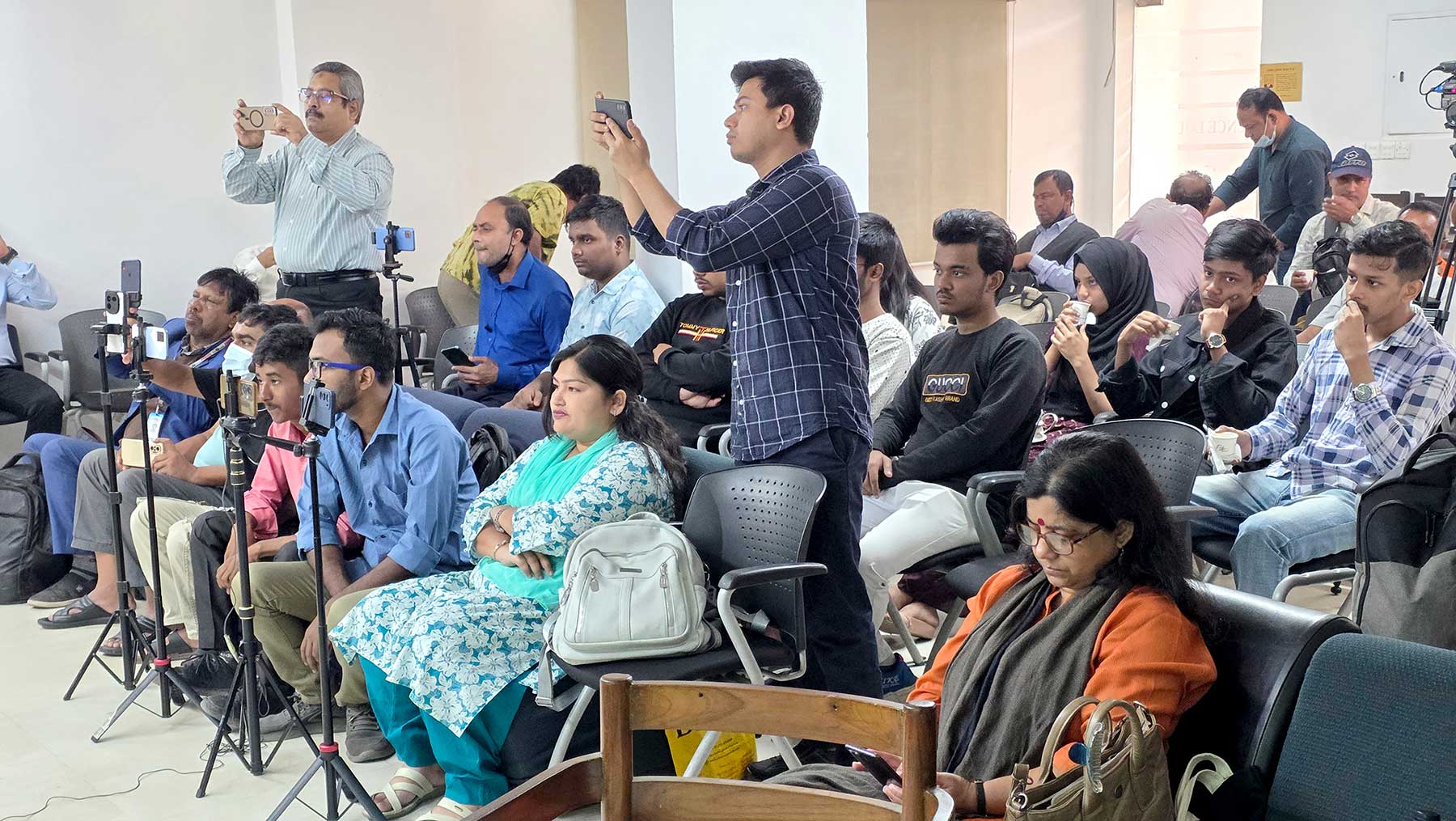
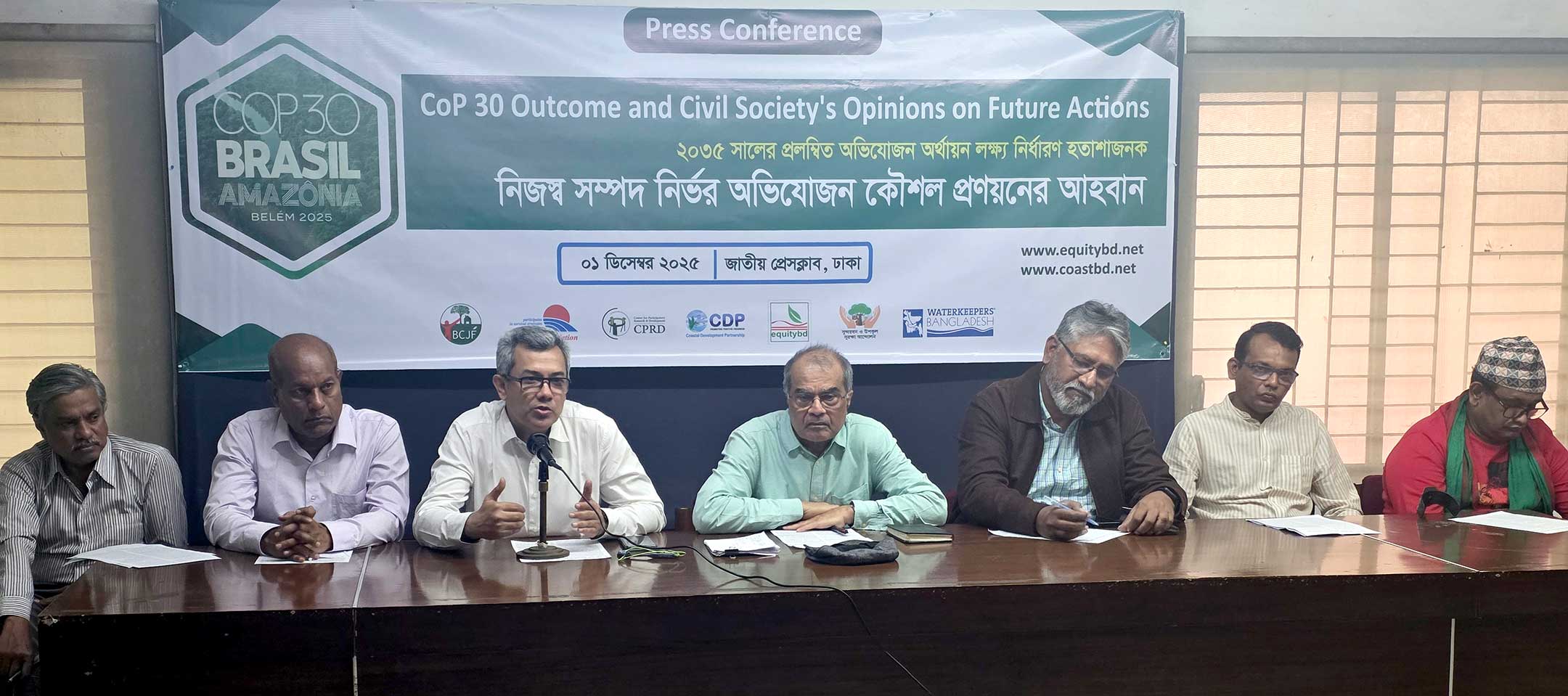
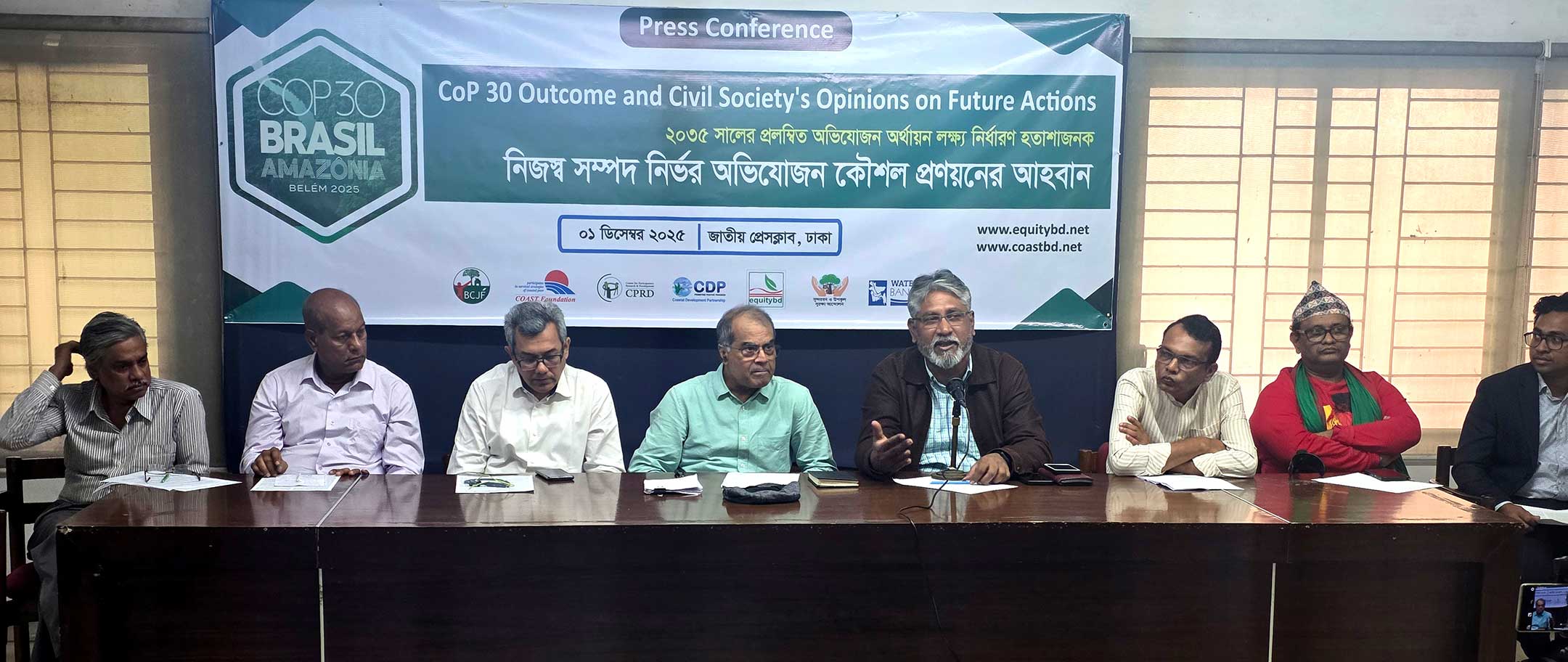
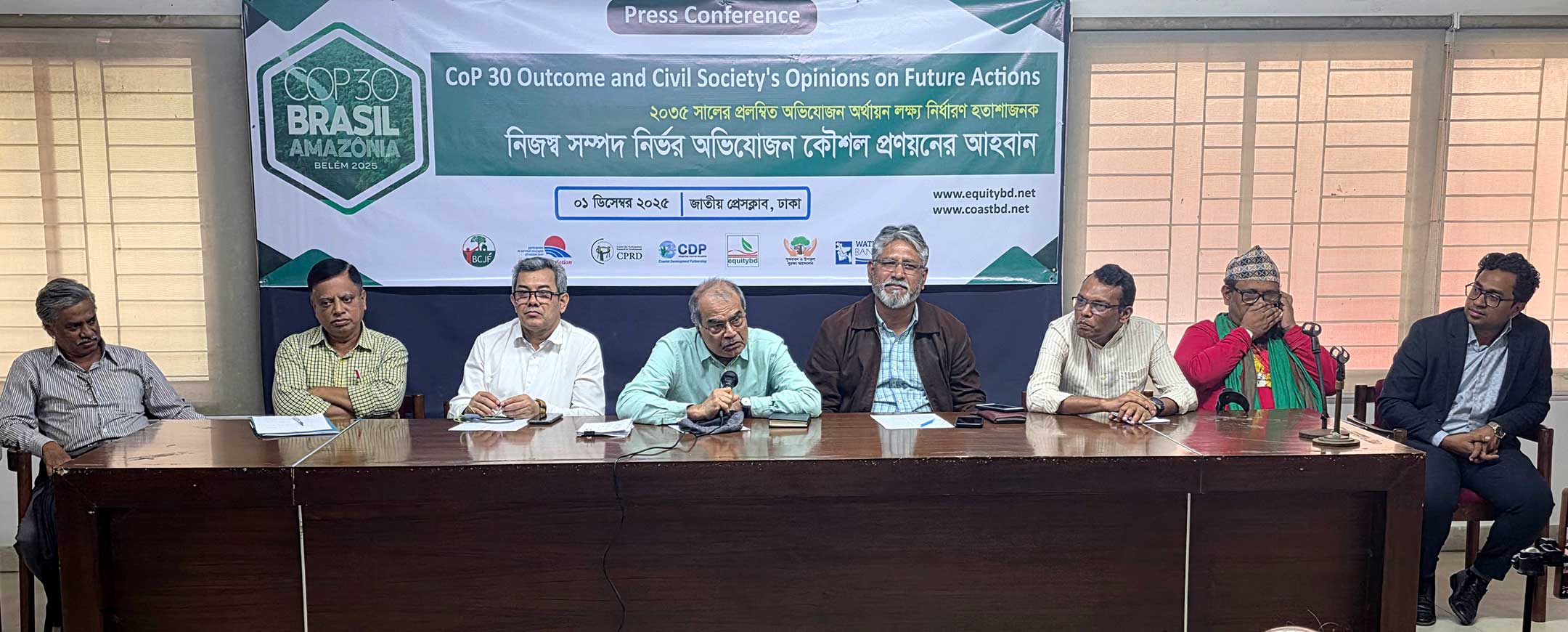
Speakers raised these demands at the press conference titled “COP-30 Outcomes and Actions in Bangladesh” held at the National Press Club in Dhaka today, December 1, 2025.COAST Foundation, CPD, CPRD, EquityBD, Sundarbans & Coastal Protection Movement, BCJF & Waters Keepers Bangladesh jointly organized this event. The press conference moderated by M. Rezaul Karim Chowdhury, Chief Moderator of EquityBD & ED of COAST Foundation. Participants of the recent COP 30 held in Belém, Brazil, spoke at the press conference. Among others, Jahangir Hasan Masum, ED of CPD, Shamsuddoha, CEO of CPRD, Sharif Jamil, CEO of Waters Keepers Bangladesh, Kausar Rahman, President and Motahar Hossain, Secretary of BCJF, Nikhil Chandra Bhadra, of Sundarbans Coast Protection Movement, Mir. Mohammad Ali, Assistant Professor, S-here Bangla Agriculture University, Saluddin Bablu of Journalist, and many others spoke. M.A. Hasan of COAST Foundation presented the keynote.
M Rezaul Karim Chowdhury said, as always, there was no specific financial commitment for LDCs and MVCs, there is considerable doubt whether there will be in the future. Climate finance will be mainly loan-based, with very little prospect of grant-based financing. Bangladesh must continue lobbying and advocacy at the international level to reach equitable justice-based climate finance by engaging other vulnerable countries. We need to take local adaptation measures, relying on our own resources, to protect climate-vulnerable communities’ people.
Shamsuddoha said there is no political commitment to implement the 59 paragraphs of the Mutirao Agreement. We have not received any decision to address climate change; only discussion issues have been mentioned. The most worrying aspect is that decisions are being made outside the main agenda of CoP, such as the Tropical Forest Forever Facility (TFFF), and it’s a kind of loan creation instrument. We need to highlight the political process. He added, the negotiation responsibility at such global conferences lies with the government representatives, so we need to give more importance to efficient negotiation representation.
Sharif Jamil stated, if climate finance cannot be ensured, how will we phase out fossil fuels. The European Union itself did not submit NDC-03 yet, but they are the ones discussing the NDC-03 monitoring process; it is just ridiculous. The decisions of this conference, especially on finance, do not carry any significance because there is no specific baseline.
Jahangir Hasan Masum said that the discussion of fossil fuels has been politically banned from the conference this time, and due to the influence of energy lobbyists, the climate discussion has now become corporate-based rather than rights-based. The whole process is bureaucratic.
Kausar Rahman said, time has come to reform the climate conference process based on climate justice. Mothar Hossain says, we must continue to demand for fossil fuels phase-out and a framework based on the climate vulnerable community demands. Nikhil Chandra Bhadra says we need to ensure transparency and political commitment in our own climate finance. Mir Mohammad Ali says expected profits from carbon trading will never come; it’s a long-term process.
M.A. Hasan stated that, vast majority climate finance comes in the form of loans. According various studies, for every $5 provided for climate finance, $7 has to be repaid. Bangladesh’s per capita climate debt is currently $80. Therefore, we need to move away from debt-based plans, and focus on the blue economy to increase own financing.
Please download related paper [Bangla Press] [English Press] [Position Paper] [Presentation]
Photos
 |
 |
 |
 |
 |
|
Newslink
 |
 |
 |
 |
 |
 |
|
 |
 |
|