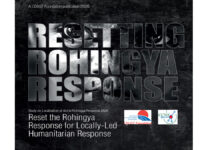

Study on Localization of Aid in Rohingya Response 2026
Reset the Rohingya Response: Local Led Humanitarian Response
This study assesses the progress of localization in the Rohingya refugee response in Bangladesh by examining humanitarian governance, leadership, financing, and partnership arrangements. Drawing on document reviews, key informant interviews (KIIs), focus group discussions (FGDs), and quantitative analysis, the study finds that localization commitments remain only partially realized.
In the Rohingya Coordination Team (RCT), UN agencies occupy 54% of the membership, while international NGOs, national NGOs, and local NGOs each hold only 15%, demonstrating continued international dominance in strategic decision-making. Across the eight humanitarian sectors, all sector leads are UN agencies, with only one international NGO serving as a co-lead, while no national or local NGO holds a sector leadership role. Humanitarian financing is even more unequal: under the 2026 Joint Response Plan (JRP), UN agencies received 87.96% of total funding, international NGOs 7.78%, national NGOs 4.26%, and local NGOs have no direct funding (0%).
During the recent three-month period reviewed, 63 humanitarian projects were approved, of which 50.8% were implemented by national NGOs, 44.4% by international NGOs, and only 4.8% by local NGOs. Although local NGOs managed just 2.5% of project funding, they remain critical frontline responders.
The study concludes that meaningful localization requires increased representation of local actors in coordination structures, equitable access to direct financing, stronger institutional capacity, and implementation of the Grand Bargain and Humanitarian Reset commitments. It also recognizes the significant advocacy contributions of COAST Foundation, CCNF, and the BDCSO Process in promoting locally led humanitarian action in Bangladesh.